One day your baby is content to stay exactly where you left them. The next, they’re pulling up on the coffee table, cruising sideways along the couch like a tiny, determined bar patron, and eyeing the dog with what can only be described as ambition.
The transition from baby to toddler doesn’t happen all at once. It unfolds in fits and starts, with plenty of tumbles, triumphs, and deeply chaotic moments in between. And for many parents, it comes with a surprising amount of anxiety, too.
Are they moving enough? Too much? Should they be crawling by now? Pulling up? Walking? And what about baby walkers — are they safe?
If you’ve found yourself spiraling through parenting forums at 11 p.m. while your baby practices standing in the crib instead of sleeping, first of all: welcome. Second: you are very much not alone.
According to developmental experts, most babies begin walking somewhere between 9 and 15 months, though there’s a wide range of what’s considered normal. Before those first independent steps come many smaller milestones: rolling, scooting, crawling, pulling up, cruising, bouncing, standing, falling down dramatically, then immediately trying again. Word to the wise: that “trying again” part may be the most important developmental milestone of all.
Walking Is About More Than Walking
When babies learn to move through the world independently, something shifts. You can almost see it happen in real time: the spark of confidence, curiosity, and delight.
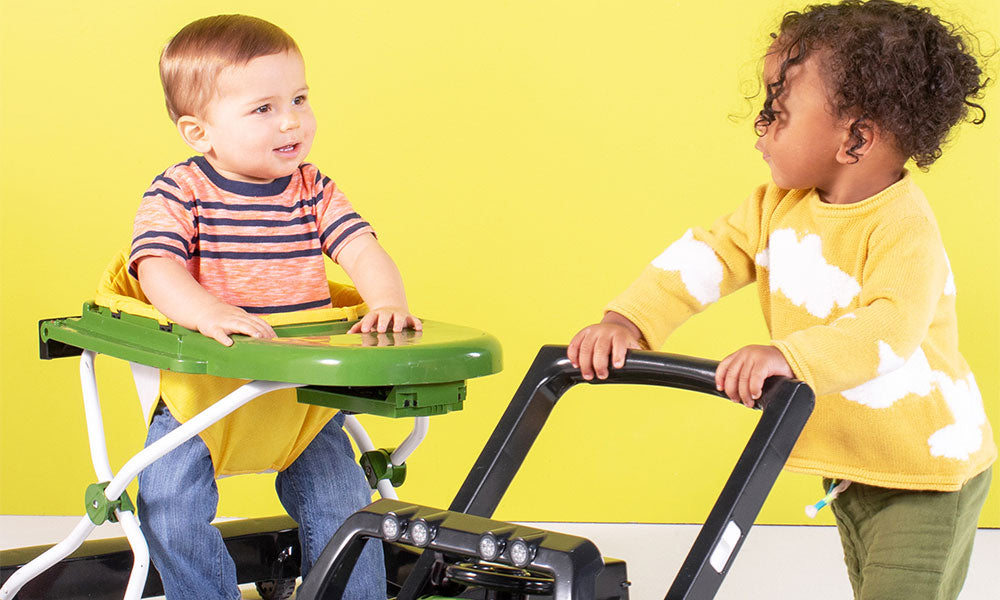
A baby who can move toward the toy they want, follow their sibling into another room, or proudly transport a single sock across the house suddenly feels a little more in charge of their own tiny universe.
Mobility supports more than physical development. It can encourage exploration, sensory learning, cause-and-effect understanding, and confidence-building through active play. Modern activity walkers are often designed around exactly those kinds of experiences: interactive play, gross motor engagement, and independent exploration.
Of course, like almost everything in parenting, the internet has complicated feelings about this.
So, Are Walkers Safe?
For years, baby walkers carried a scary reputation, largely tied to older models and serious stair-related accidents decades ago. But today’s walkers are not the same products many parents remember from the 1990s. While lower-quality, non-compliant walkers can still be found online and through unregulated sellers, branded products sold at major retailers are backed by extensive safety testing and high product integrity standards.
In fact, injuries associated with walkers have declined significantly — by roughly 85% since 1990 — thanks in large part to stricter federal safety standards introduced in 2010.
Modern standards now require features like:
- Stair-fall prevention testing
- Improved stability
- Structural integrity requirements
- Occupant retention protections
That doesn’t mean parents should leave babies unattended in walkers or use them excessively. (No baby product replaces supervision. Unfortunately, even the fanciest baby gear cannot make coffee or answer Slack messages for you.) But it does mean the conversation around walkers deserves a little more nuance than many parents realize.
Research around walkers has shown that babies develop within normal timelines particularly when walkers are used as part of a balanced approach to movement and play. It’s also worth noting how dramatically modern walker safety standards and product testing have evolved. According to data from the manufactures of Bright Starts, Baby Einstein, and Ingenuity (Kids2 Consumer Data), more than 3.5 million walkers were sold between 2020 and 2025, with extremely low incident rates reported: less than .0001%.
The Bigger Picture: Confidence, Curiosity, and Joy
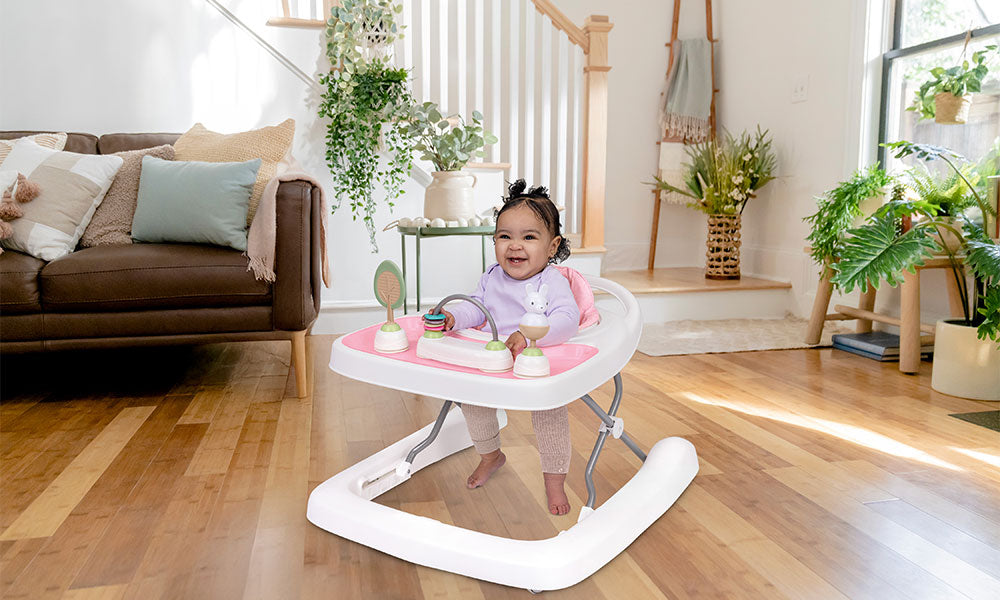
Used thoughtfully and for about 20 minutes at a time, modern walkers can be one playful tool among many that help babies engage with their environment and practice new skills in exciting ways. For many babies, that means discovering cause and effect (“If I push this button, music happens!”), building confidence through movement, and experiencing the pure joy of independent exploration. Walkers can also encourage gross motor engagement, interactive play, and parent-child connection — whether you’re cheering on those wobbly first movements from the couch or following your suddenly very mobile baby as they proudly make laps around the kitchen island like they own the place.
In other words: a walker is a tool, not a lifestyle.
A Few Walkers We Love
Baby Einstein Ocean Explorers 3 in 1 Walker
With 3 height positions and 3 ways for baby to play and learn, little ones will love to explore the sights and sounds of the sea in this submarine-themed walker.
Bright Stars Wanderlights 2 in 1 Walker
Help baby build early exploration and independence while they play. Rewarding them with lights and sounds as they work towards their first steps, this developmental walker includes a removable light-up spinner toy and 2 modes: walker mode and floor play mode.
Ingenuity Smooth Strides Walker
Give baby options for independent play with the included removable bead chaser toy that attaches to the tray for entertainment. Or attach baby's other favorite toys. A three-position adjustable height bar means this walker can remain in use even through a few growth spurts.
One thing I’ve learned as a parent is that babies desperately want to participate in the world around them. They want to follow the action. They want to see what the big kids are doing. They want to feel capable.
Sometimes that means proudly pushing a toy across the living room while shrieking with joy. Sometimes it means standing independently for exactly 1.5 seconds before collapsing onto their diapered bottom and looking personally betrayed by gravity. Both count.
Development is rarely linear, and milestones are not a race. The goal isn’t perfection or acceleration. It’s giving babies safe, supportive opportunities to practice new skills, build confidence, and engage with the world around them in ways that feel exciting and empowering.
Watching a baby realize they can move independently might be one of the most hopeful things on earth. (Even if they immediately use that power to crawl directly toward the dog bowl.)